
Exterior vs. Interior Wall Insulation: Pros, Cons, and When Each Makes Sense
Search for “exterior vs interior insulation” and you'll find contractors, forum threads, and DIY channels arguing past each other — because the honest answer is a verdict with conditions, not a universal rule. Here is ours, stated plainly: for a whole building, exterior insulation is almost always the better choice, and it should be the default assumption going into any renovation or new build. Interior insulation is not a lesser cousin of exterior insulation, though — it is the correct answer in a specific, recurring set of situations, and getting it wrong in those situations causes real damage. This guide takes a position and defends it, rather than listing pros and cons without a conclusion, because a homeowner reading a comparison article is usually trying to make one specific decision about one specific wall, not collect a balanced set of trivia.
Why exterior insulation is usually the better default
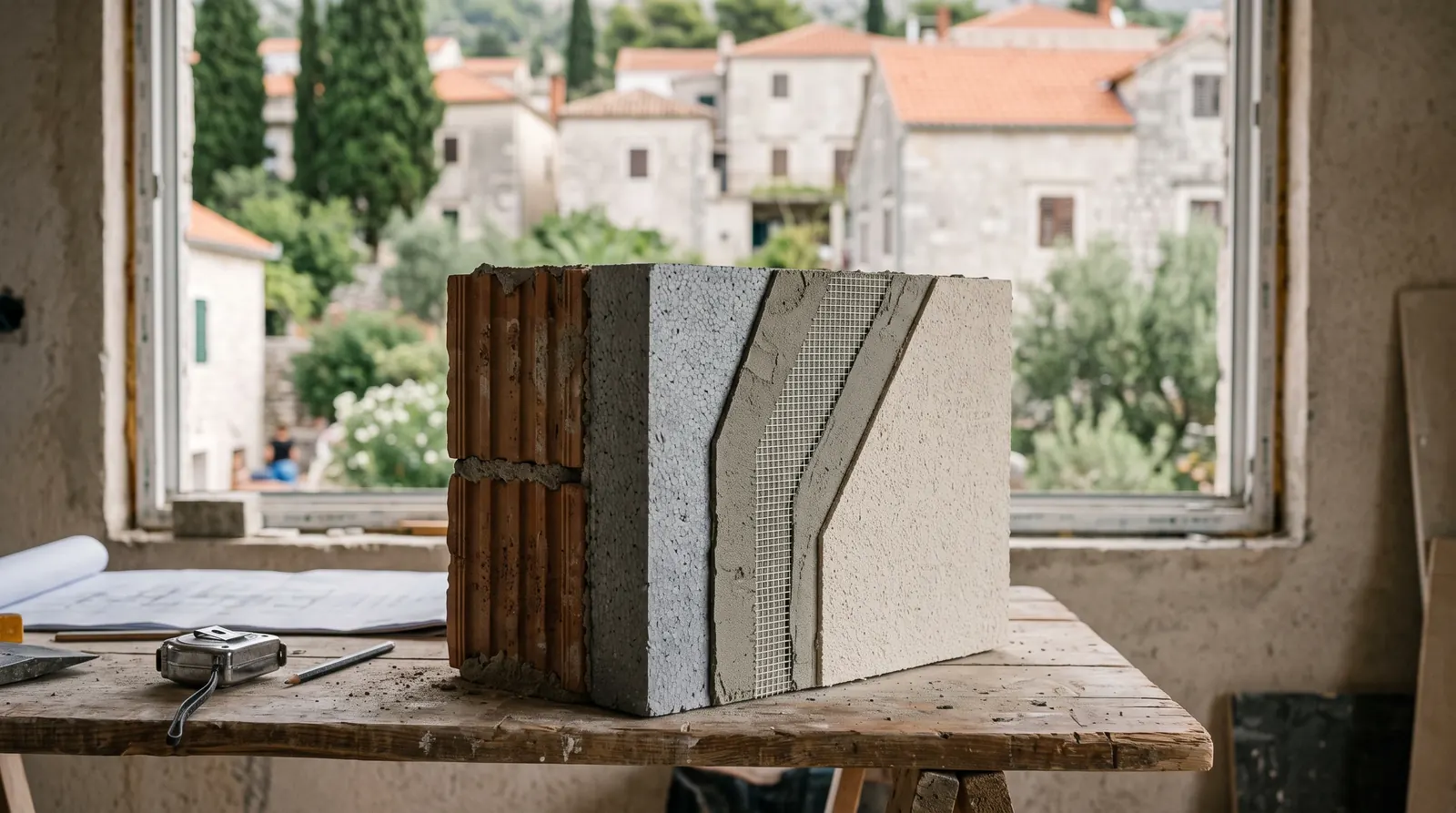
Exterior insulation — a rendered composite system fixed to the outside of the wall — wraps the entire structure in a continuous layer. Because the insulation sits outside the structural wall, the wall itself stays inside the building's thermal envelope: warm, dry, and shielded from the freeze-thaw cycling and temperature swings that otherwise stress masonry and render over decades. It also removes far more thermal bridges than an interior system can, because balconies, floor slabs, and internal partition walls all tie into the structural wall from the inside — an exterior layer simply passes over the top of all of them, while an interior layer has to work around each one individually, at real added labor cost, or leave it uninsulated and accept the bridge. And because the added thickness sits outside the wall, exterior insulation costs no interior floor area, which matters in a market where usable square meters are expensive.
Where exterior insulation runs into real limits
None of that makes exterior insulation universally available, though. It requires access to and authority over the entire facade, which rules it out in several common situations:
- Protected or listed facades — heritage rules frequently prohibit changing the external appearance of a building, which removes exterior insulation as an option regardless of its technical advantages.
- A single apartment in a multi-unit building — an individual owner typically cannot alter the shared facade unilaterally; exterior insulation on an apartment block is a whole-building decision, usually made collectively or by the building association, not by one flat owner.
- Party walls and shared boundaries — a wall shared with a neighboring building has no exterior face available to insulate at all.
- Budget or timeline constraints on one room — scaffolding an entire facade for a single problem room is rarely proportionate; sometimes the honest answer is to treat the specific wall from the inside rather than mobilize an exterior project for it.
In every one of these situations, interior insulation is not a compromise — it is the correct engineering answer to the actual constraint in front of you, and treating it as a lesser fallback rather than a deliberate choice is exactly what leads to it being specified poorly.
How interior insulation works, and why it needs more care
Interior insulation fixes rigid boards, or a framed and filled stud layer, to the inside face of the existing exterior wall, then finishes it with a vapor control layer and interior lining. The physics work the same way — trapped air resists heat transfer — but the risk profile is different, and this is the part that a purely pro-vs-con list tends to understate: because the structural wall now sits outside the insulation, it stays colder and wetter than it would with exterior insulation, which raises the risk of interstitial condensation inside the wall assembly if the vapor control layer is missing, damaged, or positioned on the wrong side. Moisture that condenses inside a wall it cannot dry out of is one of the more common causes of hidden mold and material decay in older buildings retrofitted with interior insulation by an inexperienced installer. The thermal bridges at floor slabs, internal partitions, and window reveals that exterior insulation simply passes over also remain largely unresolved with an interior system, because insulating around every one of those junctions from the inside is far more labor-intensive and easy to skip.
None of this means interior insulation is unsafe — it means it is less forgiving of shortcuts, and it should be specified and installed by someone who designs the vapor control layer deliberately for the specific wall build-up, rather than treated as an off-the-shelf DIY product.
Does internal wall insulation cause mold?
Internal insulation itself does not cause mold — a missing or incorrectly positioned vapor control layer does, on any wall, with any insulation type. The mechanism is straightforward: warm, moist indoor air reaches the cold structural wall behind the new insulation layer and condenses there if nothing stops it. A correctly designed interior insulation system either includes a vapor control layer sized and positioned for the local climate and the specific wall construction, or uses a vapor-open (“smart” or capillary-active) insulation material designed to let the wall dry inward when conditions allow. Skipping this step — treating interior insulation as “just add boards to the wall” — is the actual cause of the mold problems that give interior insulation its reputation, not the insulation itself.
Is exterior insulation always worth the extra disruption?
For a whole building undergoing renovation anyway — scaffolding up, facade being touched regardless — yes, because the marginal cost of adding exterior insulation to an already-planned facade project is far lower than mobilizing it as a standalone job later. For a single room in an otherwise untouched building, the calculus changes: putting up scaffolding and re-rendering an entire facade to insulate one bedroom rarely makes sense, and a well-detailed interior solution for that specific wall is the proportionate answer instead.
What about energy performance and building permits?
In many jurisdictions, a facade-wide exterior insulation project is treated differently by permitting and energy-certification rules than a single interior wall retrofit, because it changes the building's external appearance and its overall energy performance rating, while an interior job on one wall typically does not. This is worth checking locally before assuming either path is the simpler paperwork route — sometimes the interior option is administratively the lighter one precisely because it changes nothing on the outside of the building.
Exterior vs. interior insulation, side by side
- Thermal bridging — exterior insulation removes most bridges by wrapping over them; interior insulation leaves floor, partition, and window junctions as bridges unless each is individually detailed.
- Moisture risk — exterior insulation keeps the structural wall warm and dry; interior insulation raises interstitial condensation risk without a correctly designed vapor control layer.
- Floor area — exterior insulation costs none; interior insulation reduces usable room area by the thickness of the new layer.
- Facade appearance and structure protection — exterior insulation renews and protects the facade finish; interior insulation leaves the existing facade and its weathering exposure unchanged.
- Where it's allowed — exterior insulation needs authority over the whole facade; interior insulation is the option where that authority does not exist.
- Disruption — exterior work happens from scaffolding outside, with the building occupied throughout; interior work happens inside the room being treated, which is more disruptive to that specific space while it's underway.
A quick self-check: which situation are you in?
- You own the whole building, or you're building new — default to exterior insulation; there is rarely a good reason not to when the facade is fully yours to work with.
- You own one apartment in a block, and the facade is shared — interior insulation on your own walls is very likely your only realistic option unless the whole building association agrees to a facade project.
- Your building has a protected or listed facade — interior insulation, carefully specified, is the path forward; exterior insulation is not available to you regardless of its technical merits.
- You're renovating one room and the rest of the building is untouched — interior insulation on that wall, done properly, is the proportionate choice over a standalone exterior project.
- Your facade is already being touched for another reason — render repair, repainting, cladding replacement — add exterior insulation to that project rather than treating it as a separate decision later.
What to ask before committing to interior insulation
Because interior insulation is less forgiving of a rushed specification, it is worth confirming a few things with whoever designs and installs it, rather than assuming a generic product will work on any wall. Has the vapor control layer been sized for this specific wall construction and this specific climate, rather than applied as a standard default? Has anyone checked where the dew point falls within the finished wall assembly, so condensation risk inside the wall has actually been calculated rather than assumed away? Is there a specific plan for the floor slab, internal partition, and window reveal junctions, or does the plan stop at the flat wall areas? And is the chosen insulation material itself vapor-open enough to allow the wall to dry inward if some moisture does get in, or is it a fully vapor-closed system that depends entirely on a perfect membrane with no margin for error? A contractor who can answer all four without hesitation is specifying interior insulation the way it needs to be specified; one who can't is treating it as a simpler job than it actually is, and that gap tends to show up years later as a damp patch rather than at handover.
Is interior insulation actually cheaper, or does it just look that way?
Interior insulation is often quoted at a lower price per square meter of wall than exterior insulation, mainly because it avoids the cost of scaffolding and facade finishing. Taken at face value, that makes it look like the budget option. But a fair comparison has to include what the sticker price leaves out: the lost floor area has a real value in any market where usable space is sold or rented by the square meter, the vapor control design and junction detailing that a safe interior system requires is itself a cost that a bare per-square-meter board price doesn't capture, and a wall that still carries unresolved thermal bridges keeps losing some of the energy the project was meant to save. None of this means interior insulation is a bad deal — in the situations where it's the right choice, it's the right choice on the merits, not despite the cost. It does mean the two options are not directly comparable on price alone, and a quote that only shows board-and-labor cost per square meter is not yet a complete answer.
So which one should you choose?
Default to exterior insulation whenever the facade is available to you — as a whole-building owner, as part of a planned facade renovation, or as a new build. Choose interior insulation deliberately, not as a fallback of convenience, when the facade genuinely cannot be touched: a protected building, a single apartment inside a block you don't control, a shared party wall, or a single-room fix that doesn't justify a facade project. In that second case, specify a vapor control layer designed for your specific wall and climate, and have a professional detail the floor, partition, and window junctions rather than insulating the flat wall areas only. Either path is legitimate engineering — the mistake is picking interior insulation by default because it seems simpler and cheaper on paper, without designing for the moisture risk it introduces or pricing in the floor area and thermal-bridge trade-offs that come with it.
For the underlying mechanics of how thermal insulation works before comparing placement options, see our thermal insulation 101 guide; for the material choice once placement is decided, see how to choose the right insulation; and for the mold and condensation failure modes in more depth, see our common insulation mistakes guide. Get in touch to have your specific wall assessed rather than guessed at.
Is interior insulation cheaper than exterior insulation?
Often per square meter of wall, yes, mainly because it avoids scaffolding — but that comparison is misleading on its own, because interior insulation also reduces usable floor area and requires a properly designed vapor control layer to avoid condensation risk, both of which have real costs that a simple per-square-meter price doesn't capture.
Can I mix exterior insulation on most walls and interior insulation on one problem wall?
Yes — the choice is made wall by wall, not as an all-or-nothing decision for the whole building; a shared party wall or a single wall inside a protected facade is routinely insulated from the inside while the rest of the building is insulated from the outside.
Does interior insulation reduce room size noticeably?
Yes, by roughly the thickness of the added insulation and lining layer on every treated wall, which is a real trade-off worth weighing against the alternative of leaving a wall uninsulated in situations where exterior insulation isn't available.