
12 Waterproofing Mistakes That Let Water In: Roofs, Terraces, Foundations and Bathrooms
Most water damage inside a building didn't start with a bad waterproofing product — it started with one specific, avoidable mistake made during design or installation. Our companion guides on how building waterproofing works and terrace and flat-roof waterproofing cover how a correctly built system is supposed to work; this guide covers the other side of that story — the twelve mistakes that show up most often on roofs, terraces, foundations, and bathrooms, and why each one defeats an otherwise sound waterproofing system.
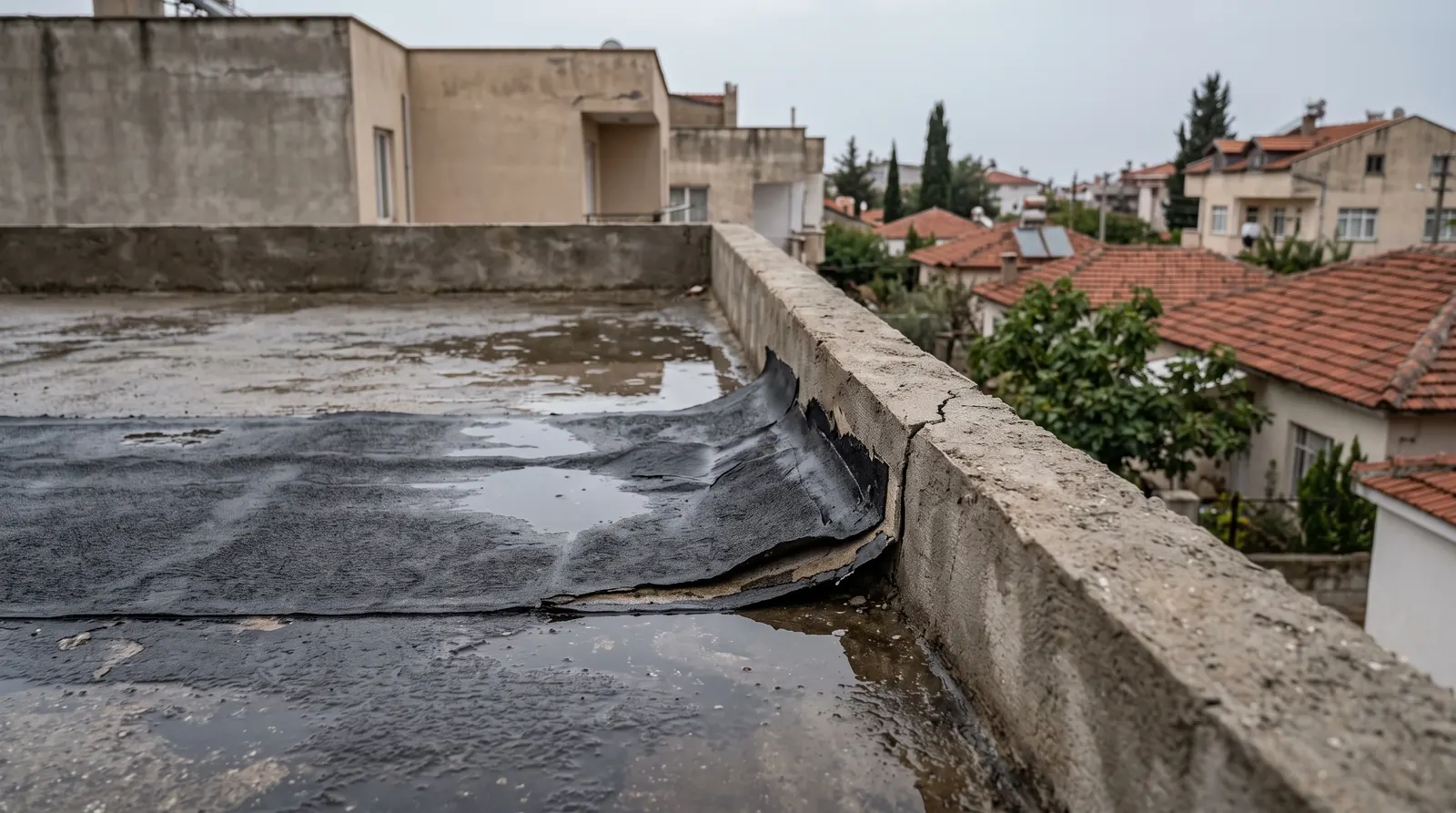
Why Does Standing Water on a Roof or Terrace Mean the Waterproofing Is Likely to Fail?
Ponding water is one of the most common and most preventable waterproofing mistakes, because a membrane that sits under standing water for long stretches after every rain is under far more sustained stress than one that briefly gets wet and dries. It usually traces back to a roof or terrace that was never built with an adequate deliberate fall toward its drains, or one where a fall that was adequate on the drawings has been undone in practice — by settlement, by debris sitting in a low point, or by furniture and planters placed without regard for where the water is meant to travel. The fix is not a better membrane; it is correcting the slope and clearing whatever is blocking the water's path, which is why an assessment of an existing roof should always start with watching where water actually sits after rain, not with inspecting the membrane in isolation.
Why Do So Many Leaks Start at Upstands, Parapets, and Door Thresholds Rather Than the Flat Field?
The flat area of a membrane is the easiest part to install correctly and the least likely part to fail; the junctions where it has to turn a corner and climb a wall, a door threshold, or a roof-mounted unit are where the work actually gets difficult, and skipping or rushing that detail is one of the most common mistakes in the whole trade. If the membrane isn't carried high enough up the vertical surface, isn't properly terminated at the top, or isn't sealed tightly at the corner where it turns, water finds that gap eventually — often long after the installation crew has moved on, which is exactly why these details deserve more scrutiny in a quote and in a site inspection than the square metres of flat membrane ever will.
Can Skipping Primer or Rushing Surface Preparation Really Cause an Entire Membrane to Fail?
Yes, and it's one of the most avoidable mistakes on this list because it costs almost nothing to do correctly and almost everything to skip. A waterproofing membrane bonds to the surface beneath it, and dust, loose particles, oil residue, or moisture on that surface can prevent proper adhesion no matter how good the membrane product itself is; a primer exists specifically to give the membrane something reliable to bond to. A membrane applied over a poorly prepared surface can look perfectly installed on the day it goes down and still fail within a season, because the failure is happening at a bond line nobody can see once the membrane is in place — which is exactly why surface preparation deserves as much attention in a quote as the membrane brand itself.
What Happens When a Later Trade Punctures an Already-Finished Waterproofing Membrane?
A waterproofing membrane is often finished long before a project is, and every trade that works on top of it afterwards — the crew fixing pedestals for a paver terrace, the electrician running a conduit, the landscaper backfilling against a foundation wall — is a chance for it to be punctured, scraped, or torn without anyone reporting the damage. A single unnoticed puncture is enough to defeat an otherwise correctly built system, because water doesn't need much of an opening to find its way through and then travel sideways under the membrane before it shows up somewhere else entirely, which is part of why a leak's visible location is often nowhere near its actual source. The practical fix is treating a finished membrane as a protected work area during every later trade, not just during its own installation, and inspecting it again before it gets covered for good.
Why Shouldn't a Waterproofing Membrane Be Applied Rigidly Across a Structural or Expansion Joint?
Buildings move — slightly with temperature, more significantly with structural settlement — and a joint that was deliberately left in the structure to accommodate that movement needs a waterproofing detail that can move with it, not a membrane bonded rigidly straight across it. A membrane applied as if the joint weren't there will eventually crack along exactly that line, because the two sides of the joint aren't moving together, and the crack usually shows up as a leak with no obvious cause until someone traces it back to the joint underneath the finished surface. The correct detail carries the membrane across the joint with enough slack, or a purpose-made joint cover, to accommodate that movement without tearing — a detail that has to be planned before the membrane goes down, not patched in afterwards.
Can a Blocked or Undersized Drain Undo an Otherwise Correctly Built Waterproofing System?
Yes, and it's one of the mistakes that has nothing to do with the membrane itself. A roof or terrace built with a correct fall and a well-detailed membrane still depends on its drains actually working, and a single drain with no secondary overflow provision is one blocked leaf pile or one ice event away from sending water somewhere it was never meant to go. Drains also need to be sized and positioned for the actual area they're expected to clear, not treated as an afterthought once the rest of the design is set; a roof drained by one small outlet in one corner asks that single point to do a job that two or three properly placed drains, with an overflow route as backup, would do far more reliably.
Why Does Bathroom Waterproofing Fail Even When the Floor Membrane Looks Fine?
Bathroom waterproofing failures concentrate at exactly the points that are easiest to skip: the corners where floor meets wall, the areas around pipe penetrations, and — most often — the wall itself behind a shower, bath, or basin, which needs the membrane carried up it to a defined height rather than stopping at the floor. Tiles and grout are not a waterproofing layer on their own; grout in particular is porous and wears with cleaning and use, so if the membrane underneath doesn't already cover the areas most exposed to water, the tile finish on top of it is cosmetic rather than protective. A related mistake is tiling before the membrane has fully cured, trapping moisture beneath a finish that then has nowhere to escape.
Why Does Mixing Incompatible Waterproofing Products Cause Problems Even When Each One Is Good on Its Own?
Waterproofing membranes, primers, and protective coatings are engineered as systems, and a manufacturer's test data and warranty apply to that system used together — not to whichever compatible-looking product happens to be on hand. Pairing a membrane from one manufacturer with a primer, sealant, or repair patch from another can look identical on installation day and still fail months later if the chemistries don't bond the way a tested system does, and by the time that failure shows up, it is usually impossible to tell from the outside which component in the stack didn't hold. This is also why a repair to an old membrane is safest when it uses a product from the same system, or one the original manufacturer explicitly lists as compatible, rather than whatever the crew has left over from another job.
Why Does a Foundation Wall Need More Than a Painted-On Waterproof Coating?
Below grade, a foundation wall is under constant hydrostatic pressure from the soil and groundwater around it, not just occasional rain, and a thin painted-on damp-proof coating designed to resist moisture vapor is a different product with a different job than a membrane engineered to resist standing water under pressure. Using a damp-proofing coating where a full waterproofing membrane is actually needed is a common source of basement and foundation leaks that only shows up once groundwater rises after a wet season, by which point the coating has usually already been backfilled over and is expensive to reach and correct. The fix is specifying the right product for the actual exposure — standing groundwater and hydrostatic pressure call for a membrane system, not a vapor-resistant paint — before the foundation is ever backfilled.
Why Does Skipping a Flood Test or Leak Test Before Covering the Membrane Matter?
A waterproofing membrane is essentially untestable once it has been covered by insulation, protection board, pavers, or backfill, which is exactly why testing it while it is still exposed — flooding a roof or terrace with water and watching for movement at drains and low points for a set period, or running an electronic leak-detection survey over the membrane before it is buried — is one of the cheapest steps in the entire project relative to what it can catch. Skipping this step to save a day of schedule means the first real test of the membrane becomes the first heavy rain after the building is occupied, at which point any fault is buried under everything installed on top of it and vastly more expensive to trace and repair than it would have been to find before cover-up.
Why Does Backfilling or Loading a Membrane Before It Has Cured Cause Problems Later?
Most waterproofing membranes have a manufacturer-specified cure or recoat window — a period during which the material is setting and is more vulnerable to damage than it will be once fully cured — and loading it early, whether by backfilling against a foundation membrane or walking pavers onto a terrace membrane, can leave permanent thinning, indentation, or incomplete bonding that never fully corrects itself even after the material finishes curing. Schedule pressure is the most common reason this happens: a crew waiting on a foundation to backfill or a terrace to hand over has an incentive to move on to the next step before the data sheet's stated time has actually passed, and the damage from doing so is often invisible until the membrane is tested by real water years later.
How Do You Know Whether a Waterproofing Problem Needs a Local Repair or a Full System Replacement?
Not every waterproofing failure means tearing out the whole system, but assuming a visible leak is always a small, local problem can be just as costly a mistake as assuming it always needs full replacement. A single, freshly discovered puncture in an otherwise sound, well-adhered membrane is usually a localized repair; a membrane that has reached the end of its expected service life, that shows widespread blistering or lifting across many areas, or where water has clearly been travelling under the surface for a long time before it showed up, is a different situation, and patching one visible spot on a membrane like that often just relocates the leak to the next weak point instead of solving it. Working out which situation applies usually means tracing how far moisture has actually spread — sometimes with a moisture meter or an infrared survey — before deciding, rather than guessing from the one damp patch that happened to be visible first.
Why Does Missing As-Built Documentation Make Every One of These Mistakes Harder to Fix?
A waterproofing system that isn't documented — which membrane brand and type was used, where the drains and joints actually sit, which areas were repaired and with what — turns every future repair into a guessing exercise instead of a straightforward match to a known, tested system. This matters directly for several of the mistakes above: a repair crew that doesn't know the original membrane's manufacturer is far more likely to pair it with an incompatible product, and a renovation crew that doesn't have a record of where the drains and falls were designed to run is more likely to unknowingly block or alter them. Keeping a simple record of the installed system — product names, drain layout, and any repairs made — at the time of installation is one of the cheapest ways to prevent the next decade of work on that same roof from repeating the mistakes covered here.
What Does a Professional Waterproofing Inspection Actually Check For?
A worthwhile inspection works through the same list this guide does, in roughly the same order: where water is standing and whether the fall is doing its job, whether upstands, parapets and thresholds are intact and properly terminated, whether the surface preparation and primer are holding at the edges of any repair, whether anything has visibly punctured or scraped the membrane since it was last checked, whether joints are still able to move freely, whether drains and overflows are clear and correctly sized, and whether any tiled, bonded, or covered area shows early staining that points to a problem building somewhere it can't yet be seen directly. Going through it in that order, rather than starting with whichever spot happens to be visibly damp, is what actually finds the real cause instead of the nearest symptom.
How Can These Mistakes Be Avoided Without Overpaying for Waterproofing?
Every mistake on this list is cheaper to prevent than to repair, and none of them require an exotic or expensive membrane — they require the fall, the drains, the details at upstands and joints, and the surface preparation to be treated as seriously as the membrane brand itself. Our waterproofing basics guide and terrace and flat-roof waterproofing guide cover what a correctly built system actually looks like at each of these points, and a written scope that names the drains, the details, and the surface preparation steps — rather than a single lump-sum line for "waterproofing" — is the clearest sign that a quote has accounted for all twelve.
If you're planning new waterproofing work or want an existing roof, terrace, foundation, or bathroom assessed for any of the mistakes above, get in touch to talk through what you're seeing.
What's the single most common waterproofing mistake?
Ponding water from an inadequate or undone roof or terrace fall is one of the most common — and it's a slope and drainage problem to fix, not a reason to blame the membrane product.
Can I repair a small puncture in a waterproofing membrane myself?
A small, promptly caught puncture is often repairable with a patch from the same membrane system, but the harder part is finding it — leaks travel sideways under the membrane, so the visible damp patch is often not where the puncture actually is, which is why a professional inspection traces the water rather than patching the first visible spot.
Is it a mistake to tile straight over a waterproofing membrane in a bathroom?
Only if the membrane hasn't fully cured yet — tiling over an uncured membrane traps moisture underneath with nowhere to go; once cured, tiling directly over a correctly detailed membrane, including up the walls behind fixtures, is the normal sequence.